Your Next Customer Is Searching for you. Are you invisible on Google and AI?
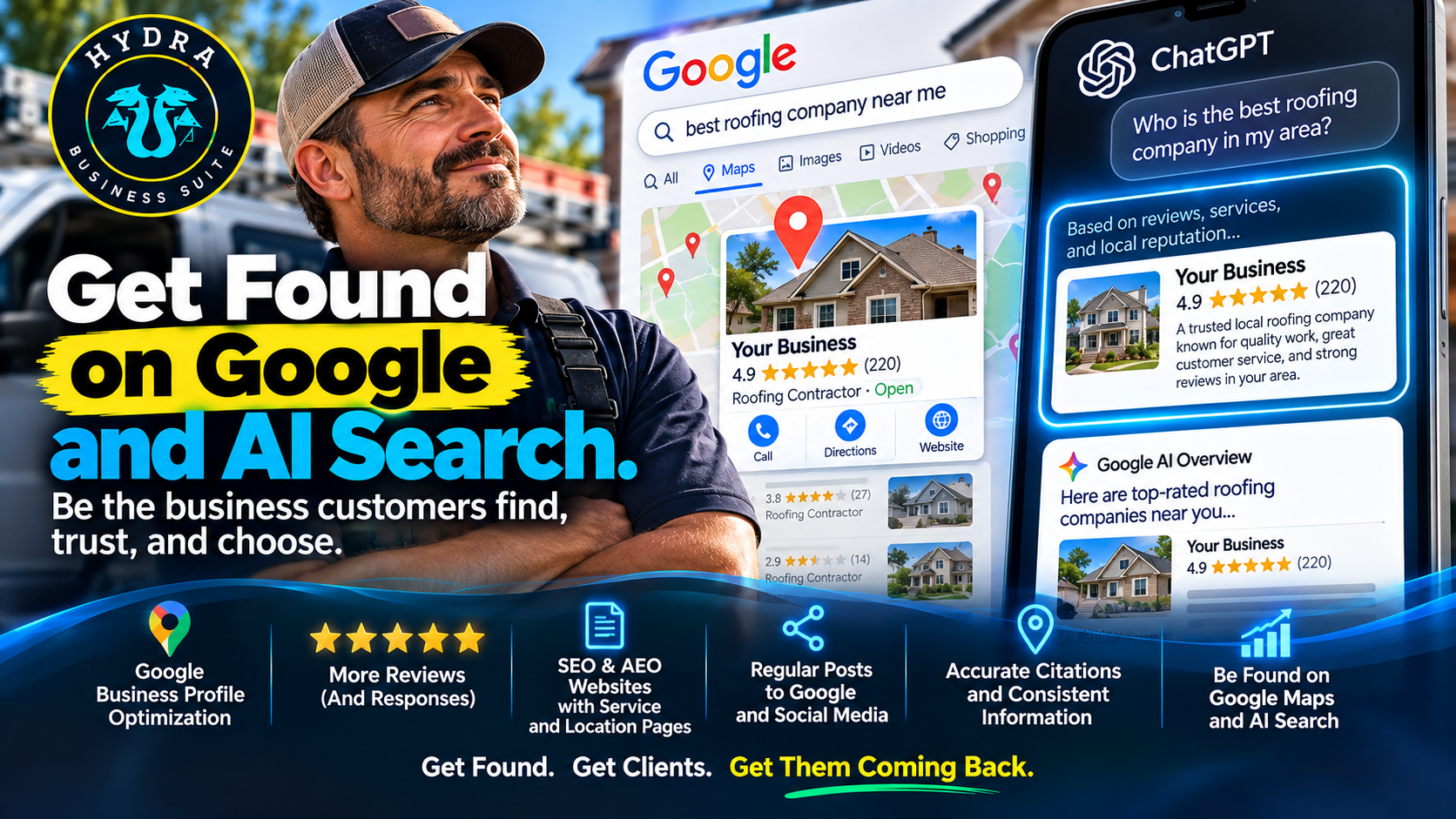
Your next customer is searching Google or asking AI for the best business in town. Are they finding YOU or your competitor? Being great at what you do means nothing if customers can't find you! Discover how Google Business Profile, customer reviews, SEO, and AI Search Optimization (AEO) work together to get your business noticed, trusted, and chosen—and how Hydra Business Suite helps make it happen.
Why Google Maps, Customer Reviews, Your Website, and AI Search Matter More Than Ever for Local Businesses
By Hydra Business Suite | Get Found. Get Clients. Get Them Coming Back.
Imagine this.
A homeowner in Phoenix needs an AC repair.
They grab their phone and search:
"Best AC repair company near me."
Google shows several businesses.
The homeowner looks at the reviews, checks a few photos, and makes a call.
But your business isn't showing up.
You have a great team. You do excellent work. Your customers love you.
Unfortunately, none of that matters if new customers can't find you.
And now there's another challenge.
People aren't just searching Google anymore.
They're asking ChatGPT, Gemini, and other AI tools questions like:
"Who's the best window repair company in Kansas City?"
"Find me a reliable landscaper in Mesa with great reviews."
"Which pest control company near me handles scorpions?"
If Google and AI search can't find clear, trustworthy information about your business, you may be missing customers who are ready to spend money.
Let's talk about how to fix that.
1. Getting Found Starts With Your Google Business Profile
<text color="secondary" italic>Think of your Google Business Profile as your digital storefront.</text>
Your Google Business Profile (GBP) is the business listing people see on Google Search and Google Maps.
It shows important information, such as your:
- Business name, phone number, and website
- Hours of operation
- Services and service areas
- Customer reviews and ratings
- Photos, videos, and updates
And here's something many business owners don't realize.
Having a Google Business Profile doesn't mean it's properly set up to help you compete.
Google says local search results are mainly based on three things:
Relevance: Does your business match what the customer needs?
Distance: How close is your business to the person searching?
Prominence: How well-known and trusted does your business appear to be?
You can't control where every customer searches from. But you can improve the quality, accuracy, and usefulness of your business information.
A complete, properly managed Google Business Profile is one of the best places to start.
2. Your Reviews Are Doing More Than Making You Look Good
Let's say you're searching for a roofing company.
You find two businesses.
One has 12 reviews and a 3.8-star rating.
The other has 175 reviews and a 4.8-star rating.
Which one are you likely to check out first?
Exactly.
Your reviews help customers decide whether they trust you before they ever speak to you.
Google also confirms that more reviews and positive ratings can help local search rankings.
But there's more to it than collecting five-star reviews.
You need a steady flow of honest reviews from real customers.
For example, a detailed review that says:
"ABC Landscaping installed a beautiful paver patio at our home in Chandler. The crew was professional, on time, and cleaned everything up."
That's valuable information for future customers.
It describes the service, the experience, and the location.
And it gives search systems more useful public information about the business.
Hydra Tip: Don't wait and hope happy customers leave reviews. Build a simple process that asks every eligible customer for honest feedback after the job is complete.
Never buy reviews or offer rewards in exchange for positive ratings.
3. Replying to Reviews Matters, Too
Here's a question.
When was the last time you replied to a Google review?
Last week?
Last month?
Never?
Ouch.
When customers take the time to leave a review, they deserve a response.
Google specifically recommends replying to reviews because it shows customers you value their feedback.
A simple response might say:
"Thank you, Sarah! We're glad our team could help with your window replacement. We appreciate you trusting us with your home."
You should also respond professionally to negative reviews.
Don't argue.
Don't get defensive.
Show future customers that you take concerns seriously and want to make things right.
Remember: Your review responses aren't just for the person who left the review. They're also for the next hundred people reading them.
4. Stop Letting Your Google Business Profile Collect Dust
When was the last time you posted an update to your Google Business Profile?
If your answer is "I didn't know I could," you're not alone.
Google allows businesses to share updates, offers, events, photos, and videos directly on their profiles.
For example:
A plumber can post about water heater replacement.
A landscaper can share before-and-after patio photos.
A pest control company can share seasonal scorpion prevention tips.
A window installer can show a recent installation.
These updates help potential customers see what you do and what's happening with your business.
Now, here's an important distinction.
Google has not confirmed that posting every day directly improves your local ranking.
But useful posts can keep your profile informative, highlight services, and help customers decide to contact you.
We recommend posting consistently, with quality being more important than simply posting every day.
5. Your Social Media Supports Your Online Reputation
Facebook, Instagram, YouTube, TikTok, and LinkedIn can all help people discover and learn about your business.
But posting random pictures and hoping someone calls isn't much of a marketing plan.
Your content should help people understand three things:
What do you do?
Who do you help?
Why should they trust you?
Show real jobs.
Share customer success stories.
Answer common questions.
Introduce your team.
Show before-and-after results.
And whenever possible, turn one great piece of content into posts for several platforms.
For example, a roofing company might share a short video explaining how to spot storm damage.
That video could become a YouTube Short, Facebook post, Instagram Reel, Google Business Profile update, and a helpful website article.
One piece of useful content. Multiple opportunities to get discovered.
Social media activity alone does not guarantee better Google rankings. But it can increase brand awareness, build trust, and encourage people to search for your business by name.
6. Your Website Needs More Than a Pretty Homepage
This is where many local businesses miss a huge opportunity.
They pay someone to build a beautiful website.
It has nice pictures, a phone number, and a contact form.
Wonderful.
But Google and AI search tools also need to understand exactly what the business does and where it provides those services.
That's where SEO and AEO come in.
SEO (Search Engine Optimization) helps search engines discover, understand, and display your website.
AEO (Answer Engine Optimization) focuses on making your information clear and helpful when people ask questions through AI-powered search tools.
The good news? Many of the same best practices help both.
Google's own guidance says strong SEO remains the foundation for appearing in its AI search features.
Every Major Service Deserves Its Own Page
Let's say you own a general contracting business.
Your homepage says:
"We offer quality home improvement services."
That's nice.
But what does that actually tell Google?
Not nearly enough.
A better website might have separate pages for:
- Window Installation
- Window Repair
- Siding Replacement
- Wood Rot Repair
- Deck Construction
- Bathroom Remodeling
- Kitchen Remodeling
Each page should explain the service, answer common questions, show real examples, and make it easy to request an estimate.
For example, a window repair page could answer:
"Can you replace broken window glass without replacing the whole window?"
That's the kind of question a real customer might ask Google or an AI assistant.
And that's exactly the kind of helpful information your website should provide.
Location Pages Help Explain Where You Work
Now let's talk about location.
Suppose your company serves Overland Park, Olathe, Lenexa, and Shawnee, Kansas.
Your website should clearly explain those service areas.
When appropriate, you might have useful location pages such as:
"Window Repair in Overland Park, KS"
"Window Replacement in Olathe, KS"
"Wood Rot Repair in Lenexa, KS"
But there's a catch.
Don't create dozens of nearly identical pages that only swap out the city name.
Google warns against low-value pages created mainly to manipulate search rankings.
A strong location page should contain genuinely useful local information, such as services offered, real projects, local customer testimonials, and common problems in that area.
Quality beats quantity.
Every time.
7. AI Search Is Changing How Customers Find Businesses
Here's where things get exciting.
Traditional search often starts with a few words:
"Best plumber Phoenix."
AI search allows people to ask much more detailed questions.
For example:
"I have a leaking water heater in Mesa. Find a reliable plumbing company that handles emergency repairs and has strong customer reviews."
AI-powered systems may gather information from websites and other available sources to help answer that question.
Google's AI Overviews and AI Mode can use multiple related searches to find helpful information.
That means your website needs to clearly explain your services, experience, locations, and answers to real customer questions.
But let's clear up a common myth.
There is no magic button that guarantees ChatGPT, Gemini, or Google AI will recommend your business.
And Google says you don't need special AI-only files or secret tricks to appear in its AI search features.
You need accurate information, helpful content, a technically sound website, and a strong online presence.
That's why we focus on both SEO and AEO.
Not gimmicks.
Real improvements that help customers and search systems understand your business.
8. Other Things That Help Your Business Get Found
Your Google Business Profile and website are the foundation.
But several other things matter.
Consistent Business Information
Your business name, address when applicable, phone number, and website should be accurate across major directories.
These listings are often called citations.
Check places such as Yelp, Bing Places, Apple Business Connect, and relevant industry directories.
Conflicting information can confuse customers and make your online presence harder to manage.
A Fast, Mobile-Friendly Website
Most customers don't want to fight with a slow website.
Make sure yours loads quickly, works well on phones, and makes calling or booking easy.
Real Photos and Videos
Show your actual team, trucks, equipment, completed jobs, and customer experiences.
Stock photos have their place.
But real work builds real trust.
Helpful FAQs and Articles
Answer the questions your customers ask every day.
For example:
"How much does window repair cost?"
"When should I replace my air conditioner?"
"What's the difference between pavers and concrete?"
"How often should I schedule pest control?"
Clear, useful answers can help your website serve customers and become a stronger information source.
Structured Website Data
Your website can include behind-the-scenes code called structured data.
This helps search engines understand certain details about your business and content.
It isn't a shortcut to the top of Google, and it doesn't guarantee an AI recommendation.
But when used correctly, it supports a well-organized website.
Trusted Links and Local Relationships
Links from legitimate local organizations, suppliers, chambers of commerce, industry groups, and other relevant websites can strengthen your online presence.
Avoid buying spammy links or paying for fake mentions.
Tracking What Actually Works
Use tools such as Google Search Console, Google Analytics, and your business reporting system to understand how customers discover you.
Track website visits, calls, forms, booked appointments, and completed jobs.
Because being found is great.
Getting found by people who become paying customers is even better.
9. How Hydra Business Suite Helps You Get Found
Now, you might be thinking:
"That sounds great, but when am I supposed to do all of this? I'm busy running my business!"
Exactly.
That's why we built Hydra Business Suite around a simple idea:
Get Found. Get Clients. Get Them Coming Back.
We help local business owners bring their online presence and customer communication together.
Depending on the services and package you choose, Hydra can help with:
Google Business Profile Optimization
We help improve the completeness and accuracy of your profile, including business details, services, categories, and other important information.
Local Search Visibility
Our Local Domination services focus on improving your business's presence across Google Maps, local search, and relevant online listings.
Review Generation and Reputation Management
We help automate honest review requests, organize incoming reviews, and support timely, professional responses.
Social Media Planning
Our Social Planner helps you organize and schedule content so your business stays active without requiring you to post manually every day.
SEO- and AEO-Ready Websites
We build websites designed to be easy for customers to use and structured so search engines can understand them.
That includes helpful service pages, location pages where appropriate, clear calls to action, mobile-friendly design, and technical SEO foundations.
AI Website Concierge
When visitors reach your website, conversational AI can help answer questions, collect information, and guide them toward booking or contacting your business.
Voice AI and Missed-Call Follow-Up
Getting found is only half the battle.
If someone calls and nobody answers, that new opportunity could disappear.
Hydra can help answer calls, send follow-up texts, gather customer information, and connect conversations with your CRM and scheduling tools.
Customer Reactivation
We also help businesses reconnect with past customers who may be ready to book again.
Because sometimes your next customer isn't new at all.
They're already in your contact list.
10. Stop Being the Best-Kept Secret in Town
Here's something I tell business owners.
You can be the best roofer, plumber, landscaper, window installer, or pest control company in your city.
You can have the best employees.
You can provide amazing service.
You can genuinely care about your customers.
But if people can't find you when they need you, your competitors have the advantage.
And with AI changing the way people search, having an accurate, helpful, trustworthy online presence is becoming even more important.
The good news?
You don't need to become an SEO expert.
You don't need to learn every AI tool.
And you don't need to spend your evenings figuring out Google.
You need a smart strategy and the right systems working together.
Ready to Get Found by More Customers?
Hydra Business Suite helps local service businesses improve their online visibility, capture more leads, turn those leads into appointments, and keep customers coming back.
We'll help you identify where opportunities are being missed and what needs to improve.
Get Found. Get Clients. Get Them Coming Back.
Revenue feeds your ego. Profits feed your family.
Ready to get found, get clients, and get them coming back?
Hydra Business Suite combines CRM, AI, automation, and real human implementation into one connected growth system.
Explore Hydra Business Suite